


Project Details
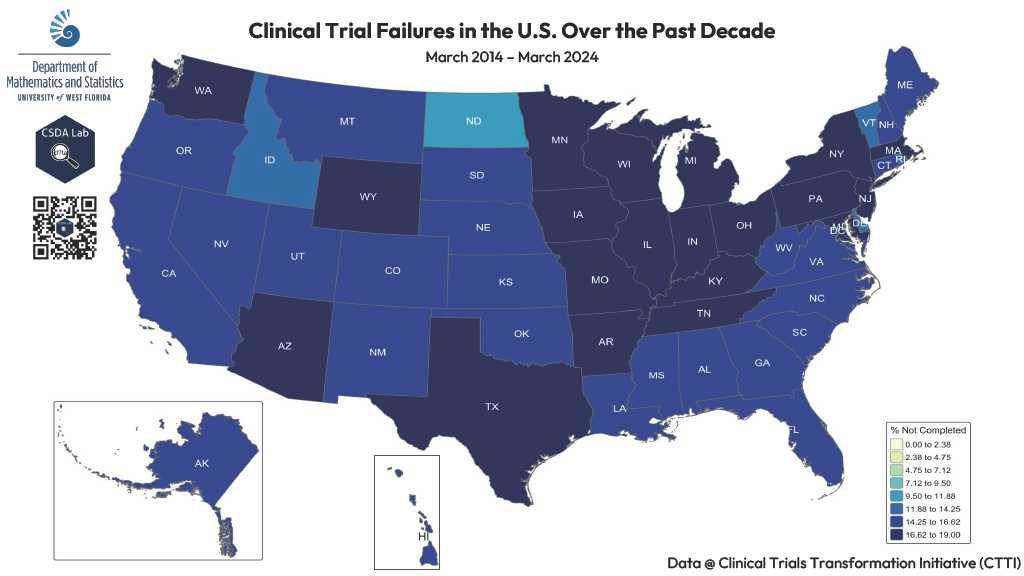
Clinical trials are the gateway to new medical treatments, yet their success hinges on the critical factor of patient enrollment. Our project addresses this pervasive issue by offering a predictive method for assessing the likelihood of a clinical trial’s success, based on historical data from the Aggregate Analysis of ClinicalTrials.gov (AACT) database. This not only aids project managers and pharmaceutical companies in strategic planning but also marks a departure from traditional, qualitative feasibility assessments.
By analyzing past trials, our model identifies the design features most associated with successful trial completion (within any medical specialty), thus enabling more informed decisions for future trials. This innovation transforms clinical trial management from a reactive to a proactive discipline, optimizing resource allocation and enhancing the probability of trial completion on time.
Employing tools such as R, PostgreSQL, the tidyverse suite for data handling, and Quarto for reporting, our interdisciplinary approach extracts success patterns from extensive trial data, driving clinical research towards a future of precision and efficiency. This progress in trial design and management not only advances healthcare research but also expands clinical trials as an accessible care option. In essence, our work not only streamlines research processes but ultimately serves patients, delivering the treatments they need and deserve.
Project Highlights
✅ Oral presenatation at the 2024 UWF Symposium (https://uwf.edu/academic-affairs/departments/undergraduate-research/student-symposium--faculty-research-showcase/)
✅ 3-Minute Thesis (3MT) presentation for the 2024 Conference of Southern Graduate Schools (https://www.csgs.org/annual-meeting) and 2024 Conference of Florida Graduate Schools (https://uwf.edu/graduate/academics-research/cfgs-2024/)